
Blog
Your AI Tools Don't Talk to Each Other. Here's What That's Costing You
July 22, 2026 · 7 min read
AI tool sprawl is what you have when a company's AI tools multiply faster than anyone coordinates them: a writing assistant in marketing, a coding agent in engineering, a meeting recorder in sales, a homegrown bot over the docs, and a scatter of personal chat subscriptions filling the gaps. Each was a reasonable call on its own. Nobody chose the whole.
It is an easy state to end up in, and for a while it looks like healthy experimentation. But now the bills are arriving and leadership is asking what the spend actually buys, and the honest answer is uncomfortable. This piece explains what AI tool sprawl is, where the money really goes, and why the obvious fix, cutting tools, treats the symptom instead of the cause.
What is AI tool sprawl?
AI tool sprawl is the uncoordinated accumulation of AI tools across a company: chat assistants, vertical copilots, homegrown bots, agent pilots, each adopted separately, each holding its own private slice of company knowledge, none of them sharing it.
The distinction that matters is sprawl versus experimentation. Trying many tools is healthy, and in the early phase it was the right instinct. Sprawl is what you are left with when the tools multiply but the knowledge does not accumulate: every tool has to be taught the company from scratch, keeps what it learns to itself, and takes that learning with it when it gets cancelled.
That difference changes what you should cut. Experimentation costs you subscriptions. Sprawl costs you the same knowledge work, over and over, with nothing compounding.
Why the visible bill is the small one
The spend a finance team can see is seats, subscriptions, and API invoices. Writer's 2026 enterprise AI adoption report put some scale on it: 59% of companies now spend over $1 million a year on AI, while 79% say adoption is getting harder rather than easier. That number is real, and overlapping tools inflate it. But it is the smallest of the costs, and fixating on it leads to the wrong fixes. The expensive part of sprawl hides in how people work around it.
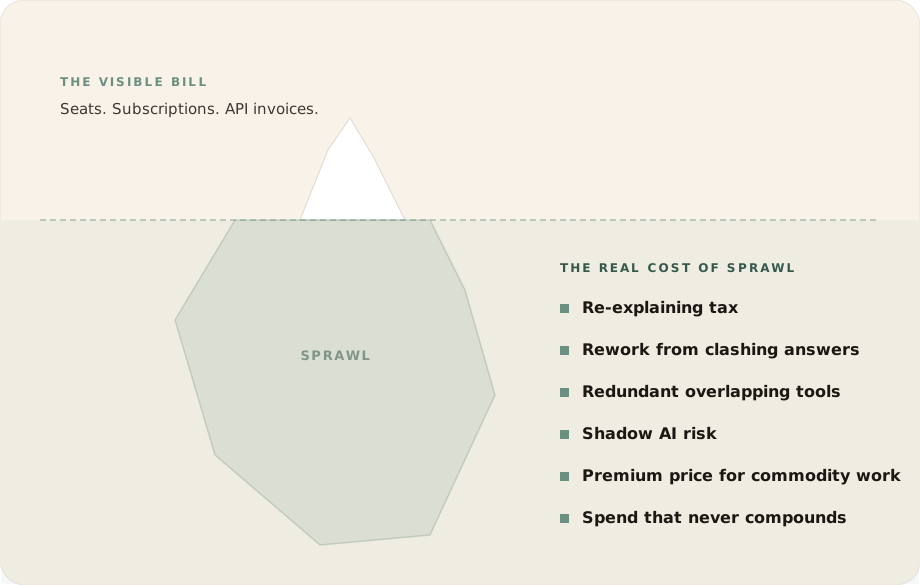
The re-explaining tax. Every disconnected tool has to be told who your customers are, what the strategy is, how you write, what got decided last quarter. So people paste the same background into five different tools, every week, without end. Multiply those minutes by headcount and the re-explaining tax outgrows the subscription bill, and it is paid by your most senior people, because they are the ones holding the context.
Rework from inconsistent output. Two teams ask their respective tools the same question and get different answers, because each tool knows a different version of the company. One agent drafts against last quarter's pricing. Another describes a feature that changed in March. Someone catches it, or does not. Either way you pay: in review time, in corrections, or in the occasional off-brand or wrong-claim incident that costs far more than any subscription.
Redundant tools doing one job. When no tool is clearly canonical, teams keep paying for all of them. Three that summarize meetings, two that draft outreach. Nobody wants to cancel one, because each holds some history the others do not. That is a sprawl cost wearing a subscription-cost disguise.
Shadow AI. When the sanctioned tools are clumsy because they know nothing, people route around them with personal accounts. The cost here is risk rather than invoices: company information flowing into consumer tools with no oversight, no access control, and no way to get it back.
Paying premium-model prices for commodity work. Most AI tools are wired to one model, usually a frontier one, and bill you accordingly. But a lot of the work does not need the top model. Summarizing a thread, tagging a ticket, drafting a first pass: a cheaper model handles these fine at a fraction of the per-token cost. When each tool is locked to a single provider, you pay the premium rate for everything, including the work that never needed it, and the inference bill climbs with usage in a way subscriptions never warned you about.
Spend that does not compound. This is the deepest one. Whatever context a tool accumulates lives inside that tool. Switch vendors and you start from zero. Every new tool starts from zero. Every departure walks knowledge out the door. Companies end up renting their own institutional knowledge back from each vendor separately, and the rent never builds equity.
Why "just consolidate" underdelivers
The instinctive fix, once the bills get attention, is consolidation: pick one vendor, one platform, one model, cut the rest.
Consolidation does shrink the visible bill. But it trades sprawl cost for lock-in cost. Betting everything on one vendor means your accumulated context lives in their format, on their terms, priced accordingly at renewal. And single-model bets age badly: the leaderboard turns over every few months, and the tool that is best for coding is rarely the one that is best for writing or analysis. We made a version of this argument in Enterprise Search, Explained: the answer to fragmented knowledge was never to buy one bigger box.
The other instinct, banning tools outright, mostly drives usage underground and feeds the shadow AI problem you were trying to solve.
Both fixes miss the diagnosis. The problem was never how many tools you run. It is that each one keeps its own version of your company.
From tool sprawl to a context layer
If the real costs all trace back to tools not sharing knowledge, the durable fix is to separate the knowledge from the tools. A context layer is a shared, living, governed source of company context that every AI tool and agent draws from: the strategy, the customers, the decisions, the voice, kept current in one place instead of re-taught in ten. It is the same gap we covered in Context Engineering vs. Prompt Engineering, seen from the cost side.
What changes financially when the context moves out of the tools:
- You route each job to the model that fits. With the context sitting in a layer rather than trapped in one vendor's tool, the same context can feed whichever model suits the task: a frontier model for the hard reasoning, a cheaper one for the routine volume. You are no longer paying Anthropic or OpenAI's top-tier rate for work a smaller model does just as well, and when prices or model quality shift, you move without re-plumbing anything.
- The re-explaining tax collapses. Context is captured once and reused everywhere, instead of retyped into every tool by every person.
- Rework drops. Tools pulling from the same source give consistent answers, and consistency is the difference between reviewing output and redoing it.
- Tools become substitutable. When the knowledge lives in a layer the tools plug into, you can swap a tool, or a model, without losing what the company has learned. That is leverage at every renewal, and the practical escape from lock-in.
- Experiments get cheaper. A new tool starts warm instead of cold, so evaluating it takes days, not months. You keep the healthy experimentation without re-paying the onboarding cost each time.
- Governance gets one address. Access control and versioning happen in one place, rather than being re-implemented, or forgotten, per tool.
The distinction is worth stating plainly:
Sprawl is expensive because every tool keeps its own version of your company. Share the context, and the tools become interchangeable. Interchangeable is cheap.
This is the category Coconut is building toward: a shared, living, model-agnostic context layer that works across the AI tools your team already uses, from Claude to ChatGPT to Copilot, with access controlled per document and every change versioned. Keep the tools that earn their seat. The context underneath stops being the reason you cannot cancel the ones that do not.
How to audit your own sprawl
If you are looking at the AI line on the budget, it helps to separate the visible cost from the real one before you cut anything:
- Inventory the spend. Every AI subscription, seat, and API bill, including the ones expensed as software. The list is usually longer than anyone expects.
- Map the overlap. Group tools by job. Where three tools do one job, ask which holds context you would miss, because that, not the feature list, is why you keep paying.
- Price the re-explaining tax. Ask five people how often they paste the same background into an AI tool, and multiply honestly.
- Find where the context lives. For each tool, ask what knowledge disappears if you cancel it tomorrow. That answer is your lock-in exposure, tool by tool.
- Pick one home for shared context. Decide where the knowledge every tool needs should live, and route new tools through it. Cutting comes after this, because once the context is shared, the cut costs you nothing but the seat.
The bottom line
Reining in AI spend is rational, and it is happening nearly everywhere at once. But cutting tools treats the symptom. The real leak is paying to teach the same company to disconnected tools, paying again in rework when they answer differently, and paying a third time in lock-in because each one holds knowledge hostage. The teams that get AI costs under control for good will not be the ones with the shortest tool list. They will be the ones that stopped paying for the same knowledge five times, by treating context as shared infrastructure the tools plug into rather than something each tool owns.